
Medicare’s Annual Enrollment Period begins October 15, 2026. For millions of Medicare beneficiaries, it’s an opportunity to review coverage and make changes for 2027.
But what exactly can you change during this period?
Can you switch Medicare Advantage plans? Change prescription drug coverage? Return to Original Medicare? Enroll in Medicare Part B? Purchase a Medicare Supplement policy?
The answers aren’t all the same.
Understanding what Medicare’s Annual Enrollment Period allows — and what it doesn’t — can help you avoid enrollment mistakes.
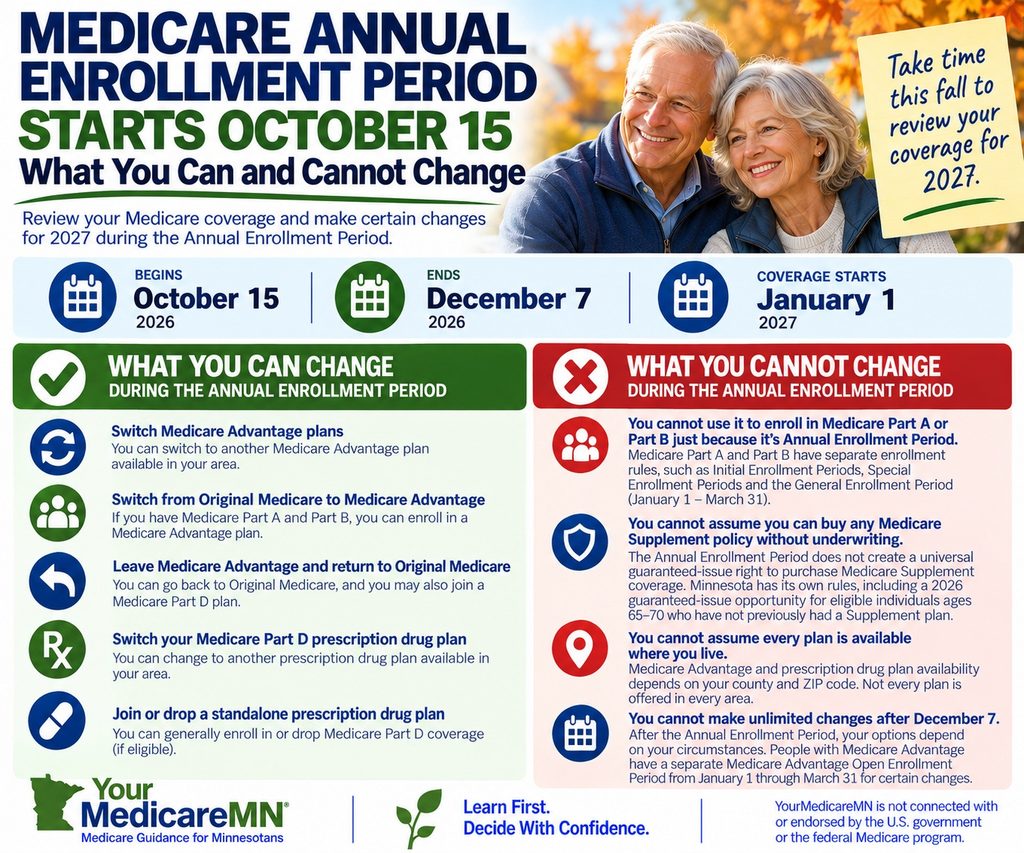
When Is Medicare’s Annual Enrollment Period?
Medicare’s Annual Enrollment Period runs from October 15 through December 7, 2026.
Changes made during this period generally take effect January 1, 2027.
During the Annual Enrollment Period, people with Medicare can make certain changes to their Medicare Advantage and Medicare prescription drug coverage.
Important: The Annual Enrollment Period is not the same as the Initial Enrollment Period for someone first becoming eligible for Medicare.
What CAN You Change During the Annual Enrollment Period?
1. Switch From One Medicare Advantage Plan to Another
If you’re enrolled in a Medicare Advantage plan, you can switch to another Medicare Advantage plan available in your service area.
For example, you may be able to change:
- From one Health Maintenance Organization plan to another
- From a Health Maintenance Organization plan to a Preferred Provider Organization plan
- From one Preferred Provider Organization plan to another
- From a Medicare Advantage plan without prescription drug coverage to one with prescription drug coverage
Enrollment in a particular plan remains subject to eligibility and service-area requirements.
Before switching, compare your doctors, hospitals, prescriptions, premiums, deductibles, copays, coinsurance and maximum out-of-pocket limits.
Remember: A lower premium doesn’t necessarily mean lower total healthcare costs.
2. Switch From Original Medicare to Medicare Advantage
If you have Medicare Part A and Part B, you can generally enroll in a Medicare Advantage plan during the Annual Enrollment Period.
Your Medicare Advantage coverage would begin January 1, 2027.
Before enrolling, understand that Medicare Advantage plans may have provider networks, referral requirements, prior authorization rules and different cost-sharing arrangements.
Also consider how the plan works if you travel or receive healthcare outside your local area.
If you currently have Medicare Supplement insurance, understand the consequences of leaving that coverage before making a change.
3. Leave Medicare Advantage and Return to Original Medicare
You can leave a Medicare Advantage plan and return to Original Medicare during the Annual Enrollment Period.
Original Medicare includes:
- Medicare Part A — Hospital Insurance
- Medicare Part B — Medical Insurance
If you return to Original Medicare, you may also want standalone Medicare Part D prescription drug coverage.
But there’s an important issue:
Returning to Original Medicare does not automatically guarantee that you can purchase a Medicare Supplement policy without medical underwriting.
Medicare Supplement eligibility and guaranteed-issue rights must be evaluated separately.
This is particularly important for Minnesota residents, where state-specific Medicare Supplement protections apply.
4. Change Your Standalone Medicare Prescription Drug Plan
If you have Original Medicare with a standalone Medicare Part D prescription drug plan, you can switch to another available prescription drug plan.
You can compare:
- Monthly premiums
- Deductibles
- Covered medications
- Formulary tiers
- Pharmacy networks
- Preferred pharmacy cost-sharing
- Prior authorization and other restrictions
Use your actual medications, dosages and preferred pharmacies when comparing plans.
The prescription drug plan with the lowest premium may not have the lowest total cost for your medications.
5. Join or Drop Standalone Prescription Drug Coverage
If you’re eligible, you can generally join a standalone Medicare Part D prescription drug plan during the Annual Enrollment Period.
You can also drop your standalone prescription drug plan.
However, dropping drug coverage deserves careful consideration.
If you go 63 consecutive days or more without Medicare prescription drug coverage or other creditable prescription drug coverage, you may face a late enrollment penalty when you enroll again.
Creditable prescription drug coverage generally means coverage expected to pay, on average, at least as much as Medicare’s standard prescription drug coverage.
Coverage from an employer, union, Veterans Affairs or another source may be creditable, but you should verify its status.
Also, not every Medicare Advantage plan can be combined with a separate standalone prescription drug plan. In some cases, joining a standalone plan can cause disenrollment from Medicare Advantage.
Check the rules for your particular coverage before enrolling.
What CAN’T You Generally Change Through the Annual Enrollment Period Alone?
1. You Cannot Use It as a General Enrollment Period for Medicare Part A or Part B
Medicare’s Annual Enrollment Period is not a general opportunity to sign up for Medicare Part A or Part B.
Those parts of Medicare have separate enrollment rules.
Depending on your circumstances, you may qualify for:
- An Initial Enrollment Period
- A Special Enrollment Period
- The General Enrollment Period, January 1 through March 31
For example, someone who delayed Medicare Part B because they were covered by health insurance based on current employment may qualify for a Special Enrollment Period.
Someone who missed their Initial Enrollment Period and doesn’t qualify for a Special Enrollment Period may need to use the General Enrollment Period.
Don’t assume that October 15 through December 7 is the correct enrollment window for Medicare Part B.
2. You Cannot Assume You Can Buy Any Medicare Supplement Policy Without Underwriting
Medicare Supplement insurance, also called Medigap, helps pay certain out-of-pocket costs associated with Original Medicare.
But Medicare Supplement enrollment is governed by rules different from Medicare Advantage and prescription drug enrollment.
The federal Medicare Annual Enrollment Period does not, by itself, create a universal guaranteed-issue right to purchase Medicare Supplement coverage.
Outside applicable enrollment protections, an insurer may be permitted to evaluate your health history and deny an application.
However, Minnesota has additional rules.
Important Minnesota exception for 2026
Beginning in 2026, Minnesota established an annual Medicare Supplement open enrollment opportunity for certain individuals.
Under the Minnesota Department of Commerce’s guidance, this guaranteed-issue opportunity applies to eligible individuals ages 65 through 70 who have not previously held Medicare Supplement coverage.
This state-specific protection is separate from the ordinary federal Medicare Advantage and prescription drug enrollment rules.
Other guaranteed-issue protections may apply when a Medicare Advantage plan terminates, leaves a service area or when other qualifying circumstances occur.
Before leaving Medicare Advantage with the intention of purchasing Medicare Supplement insurance, verify your specific eligibility, application deadlines and guaranteed-issue rights.
3. You Cannot Assume Every Medicare Plan Is Available Where You Live
Medicare Advantage and Medicare prescription drug plan availability depends on where you live.
A plan advertised in Minnesota may not be available in your county or ZIP code.
Some plans also have additional eligibility requirements.
You can compare plans available in your location using Medicare’s official Plan Finder.
4. You Cannot Assume You Can Make Unlimited Changes After December 7
December 7 is the end of the regular Annual Enrollment Period.
After that date, your options depend on your circumstances.
For example, people already enrolled in Medicare Advantage have a separate Medicare Advantage Open Enrollment Period from January 1 through March 31.
During that period, eligible Medicare Advantage members can generally make one permitted change:
- Switch to another Medicare Advantage plan, or
- Leave Medicare Advantage and return to Original Medicare, with the option to join a standalone prescription drug plan.
That period is not a general opportunity for someone enrolled only in Original Medicare to join Medicare Advantage or freely switch standalone prescription drug plans.
Other Special Enrollment Periods may apply.
What About Medicare Cost Plans in Minnesota?
Minnesota beneficiaries may also encounter Medicare Cost Plans.
Medicare Cost Plans are different from Medicare Advantage plans, even though both are offered by private insurance companies under Medicare contracts.
Cost Plans have distinct enrollment, disenrollment and coordination rules.
Some Medicare Cost Plans offer optional prescription drug coverage, and the rules for combining coverage can differ from those for Medicare Advantage.
If you’re considering joining, leaving or changing a Minnesota Medicare Cost Plan, verify the specific plan’s enrollment rules and any applicable enrollment period.
Don’t assume every Medicare Advantage enrollment rule applies identically to a Medicare Cost Plan.
What Happens if Your Current Medicare Advantage Plan Is Ending?
This question is especially important for Minnesota beneficiaries in 2027.
Several major insurance companies are discontinuing or restructuring Medicare Advantage plans.
If your current plan is not renewing for 2027, you generally cannot remain in that same plan.
You will need to review your available options.
Depending on your circumstances, you may have a Special Enrollment Period that extends beyond December 7.
You may also have guaranteed-issue rights to certain Medicare Supplement coverage if you return to Original Medicare.
However, the applicable deadlines and rights depend on the reason your coverage is ending and your individual circumstances.
Keep every notice your insurance company sends you.
Those notices may be needed to establish enrollment or Medicare Supplement rights.
If your current plan is continuing, review its Annual Notice of Change to determine whether it still meets your needs.
What if You Want to Keep Your Current Medicare Plan?
You don’t have to change plans simply because the Annual Enrollment Period has arrived.
If your plan is continuing into 2027 and you’re satisfied that it still meets your needs, you generally don’t need to take action to remain enrolled.
However, review your coverage first.
Confirm that:
- Your doctors and hospitals remain available under the plan
- Your prescriptions remain covered
- Your premiums and cost-sharing are acceptable
- Your plan’s benefits continue to meet your needs
- Your plan will still be offered in your area
Reviewing your Medicare coverage doesn’t mean you have to change it.
Sometimes keeping your current plan is the right decision.
Quick Reference: What Can You Change?
| Action | During Annual Enrollment Period? |
|---|---|
| Switch Medicare Advantage plans | Yes, if eligible |
| Switch from Original Medicare to Medicare Advantage | Yes, if eligible |
| Leave Medicare Advantage for Original Medicare | Yes |
| Switch standalone Medicare Part D plans | Yes |
| Join or drop eligible standalone prescription drug coverage | Yes |
| Enroll in Medicare Part A or Part B solely because it’s Annual Enrollment Period | No |
| Automatically qualify for any Medicare Supplement policy without underwriting | No |
| Change a Medicare Cost Plan under identical rules to Medicare Advantage | Not necessarily |
| Keep a continuing plan without making changes | Generally yes |
Five Things to Do Before October 15
1. Read your Annual Notice of Change. Understand what your current plan is changing for 2027.
2. Confirm your doctors and hospitals. Verify the specific plan and provider locations.
3. Review your prescriptions. Check formularies, pharmacies, costs and coverage restrictions.
4. Compare total potential healthcare costs. Look beyond monthly premiums.
5. Understand the consequences of changing coverage. This is especially important if you’re considering moving between Medicare Advantage and Original Medicare with Medicare Supplement insurance.
The Bottom Line
Medicare’s Annual Enrollment Period begins October 15 and ends December 7, 2026.
It’s an important opportunity to review and change Medicare Advantage and prescription drug coverage for 2027.
But it is not a universal enrollment period for every part of Medicare.
Before making a change, understand what you can change, what requires a different enrollment period and what protections may apply.
For Minnesota beneficiaries, pay particular attention to Medicare Supplement guaranteed-issue rules and plans that are being discontinued for 2027.
The goal isn’t simply to change Medicare plans. It’s to make an informed decision about your coverage.
Medicare Guidance for Minnesotans
At YourMedicareMN, our focus is education first.
We help Minnesota Medicare beneficiaries understand changes to Medicare coverage, compare their options and make informed decisions based on their individual healthcare needs.
Visit Contact Us to schedule a personalized Medicare review and get answers tailored to your situation.
For official Medicare information, visit the Medicare.gov website.
YourMedicareMN is not connected with or endorsed by the U.S. government or the federal Medicare program. Plan availability and benefits vary by location and plan. Contact the plan or Medicare for complete plan information.
Learn First. Decide With Confidence.
YourMedicareMN
Medicare Guidance for Minnesotans