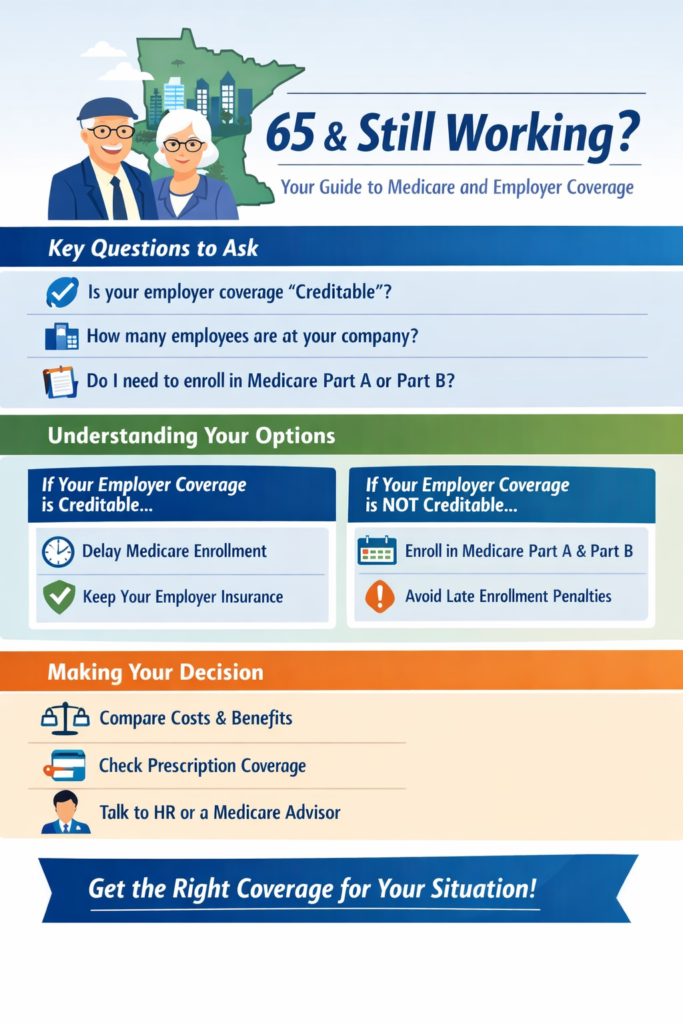
If you’re turning 65 and still working, you may be wondering whether you need to enroll in Medicare right away.
The answer depends on your situation.
If you or your spouse are still working and you have health insurance through that current employment, you may be able to delay some parts of Medicare without a late-enrollment penalty. But employer size, prescription coverage, Health Savings Accounts (HSAs), and the type of employer coverage you have can all affect that decision.
Understanding these rules before you turn 65 can help you avoid coverage gaps and Medicare late-enrollment penalties.

Do I Need Medicare at 65 If I’m Still Working?
Not necessarily.
If you have a group health plan through your current employment or your spouse’s current employment, you may be able to delay Medicare Part B until the employment or employer coverage ends.
One of the first things to determine is the size of the employer.
If the Employer Has 20 or More Employees
For most people age 65 or older, if the employer has 20 or more employees:
- The employer group health plan generally pays first.
- Medicare generally pays second.
- You may be able to delay Medicare Part B while you remain covered through your or your spouse’s current employment.
- When that employment or coverage ends, you may qualify for a Special Enrollment Period to enroll in Part B without a late-enrollment penalty.
Don’t simply assume your employer coverage qualifies. Confirm with the employer’s benefits administrator how the plan coordinates with Medicare.
If the Employer Has Fewer Than 20 Employees
For most people age 65 or older, if the employer has fewer than 20 employees:
- Medicare generally pays first.
- The employer group health plan generally pays second.
This distinction is important.
If Medicare should be your primary insurance but you haven’t enrolled in Medicare, the employer plan may not pay expenses that Medicare would normally have paid.
If you or your spouse work for an employer with fewer than 20 employees, talk with the employer’s benefits administrator or insurance carrier before deciding to delay Medicare.
Different Medicare coordination rules can apply in certain situations, including disability and End-Stage Renal Disease (ESRD).
Part B: Coverage Based on Current Employment Matters
You may hear the phrase “creditable coverage” when discussing whether you can delay Medicare.
It’s important to understand that this term is particularly relevant to Medicare Part D prescription drug coverage.
For purposes of delaying Medicare Part B, the important question is generally whether you’re covered by a group health plan based on your current employment or your spouse’s current employment.
That distinction matters because not every type of health insurance allows you to delay Part B without potential consequences.
For example:
- Active-employer group coverage may allow you to delay Part B.
- COBRA is not considered coverage based on current employment for the Part B Special Enrollment Period.
- Retiree coverage generally isn’t considered coverage based on current employment for purposes of delaying Part B.
Before delaying Part B, confirm that your coverage is based on current employment and find out whether Medicare or the employer plan will pay first after you turn 65.
What About Medicare Part A?
Most people qualify for Medicare Part A without paying a monthly premium because they or their spouse paid Medicare taxes while working.
Because of this, some people enroll in Part A when they turn 65 even though they’re continuing to work.
However, there is one particularly important reason you may want to delay Part A:
If You Contribute to an HSA, Pay Special Attention
Once you’re enrolled in Medicare, you can no longer contribute to a Health Savings Account (HSA).
That includes enrollment in Medicare Part A.
There is another issue that people working past 65 sometimes overlook.
If you enroll in premium-free Part A after age 65, your Part A coverage may be retroactive for up to six months, but it won’t begin earlier than the month you first became eligible for Medicare.
That retroactive Medicare coverage can affect your HSA contribution eligibility.
If you’re working past 65 and contributing to an HSA, Medicare generally advises stopping HSA contributions at least six months before applying for Medicare or Social Security when the six-month retroactivity rule applies.
Because HSA contributions also involve federal tax rules, consider discussing your specific contribution limits and timing with your employer, benefits administrator or tax professional.
What About Medicare Part D Prescription Drug Coverage?
Prescription drug coverage has a different set of rules.
If you’re considering delaying Medicare Part D because you have prescription coverage through your employer or another source, determine whether your current prescription coverage is considered creditable prescription drug coverage.
Creditable prescription drug coverage generally means that the coverage is expected to pay, on average, at least as much as Medicare’s standard prescription drug coverage.
Your employer or health plan should provide a notice telling you whether your prescription coverage is creditable.
Keep that notice.
In general, if you go 63 days or more after becoming eligible for Medicare without Medicare prescription drug coverage or other creditable prescription drug coverage, you may have to pay a Part D late-enrollment penalty if you enroll in Part D later.
Already Receiving Social Security?
If you’re already receiving Social Security retirement benefits before you turn 65, you may be automatically enrolled in Medicare Part A and Part B when you become eligible for Medicare.
That means you shouldn’t assume that continuing to work means you can simply ignore Medicare enrollment.
Review the Medicare information you receive before your 65th birthday.
If you plan to continue working and want to delay Part B, determine what action you need to take before your Medicare coverage begins.
This is particularly important if you have an HSA because Medicare enrollment affects your eligibility to make HSA contributions.
What Happens When I Retire?
If you delayed Medicare Part B because you had group health coverage based on your current employment or your spouse’s current employment, you generally have a Special Enrollment Period (SEP) when that employment or coverage ends.
The Part B Special Enrollment Period generally lasts 8 months.
The eight-month period generally begins when:
- The employment ends, or
- The group health coverage based on current employment ends,
whichever happens first.
However, having eight months to enroll doesn’t necessarily mean you should wait eight months.
Waiting can create a gap between the end of your employer coverage and the beginning of Medicare.
If you know when your employer coverage will end, plan your Medicare enrollment in advance so your Medicare coverage can begin when you need it.
Don’t Confuse COBRA With Active-Employer Coverage
COBRA allows many people to continue employer health coverage after employment ends, but Medicare treats COBRA differently from coverage based on current employment.
COBRA does not extend your Medicare Part B Special Enrollment Period.
If you delay Part B while actively working and then retire, your 8-month Part B Special Enrollment Period generally begins when your employment or active-employer coverage ends — not when your COBRA coverage eventually ends.
Waiting until COBRA ends before enrolling in Medicare can potentially result in a coverage gap and a Part B late-enrollment penalty.
If you’re approaching retirement and considering COBRA, review your Medicare enrollment timing before making that decision.
What Happens to My Medicare Options When Employer Coverage Ends?
When you eventually leave employer coverage, enrolling in Medicare Part A and Part B may be only part of the decision.
Depending on your circumstances, you may also need to consider:
- Original Medicare
- Medicare Advantage
- Medicare Supplement (Medigap)
- Medicare Part D prescription drug coverage
Each has its own enrollment rules and deadlines.
Medicare Supplement coverage is particularly important to consider when enrolling in Part B.
Federal law provides a six-month Medigap Open Enrollment Period that generally begins the first month you’re 65 or older and enrolled in Medicare Part B.
Minnesota also has state-specific Medicare Supplement laws and enrollment protections. Your rights and available coverage can depend on the circumstances and the rules in effect when you’re enrolling.
Review your Medicare options before your employer coverage ends rather than waiting until after you’ve retired.
A Medicare Checklist for People Working Past 65
Before deciding whether to enroll in Medicare at 65:
1. Find out how many employees your employer has.
Employer size can determine whether Medicare or your employer health plan pays first.
2. Confirm that your coverage is based on current employment.
Ask whether the coverage is based on your current employment or your spouse’s current employment.
3. Ask which insurance pays first after you turn 65.
Don’t assume your employer plan remains primary.
4. Check your prescription drug coverage.
Ask whether your employer prescription drug coverage is considered creditable for Medicare Part D and keep the written notice.
5. Check your HSA before enrolling in Medicare.
If you contribute to an HSA, understand how Medicare enrollment — including possible retroactive Part A coverage — affects your ability to make contributions.
6. Determine whether you’ll be automatically enrolled.
If you’re already receiving Social Security benefits, you may be automatically enrolled in Medicare when you become eligible.
7. Plan ahead if you’re retiring.
Don’t wait until your employer coverage has already ended to start investigating Medicare.
8. Don’t assume COBRA allows you to postpone Medicare.
COBRA does not extend the Part B Special Enrollment Period.
Should I Keep My Employer Plan or Enroll in Medicare?
There isn’t one answer that applies to everyone.
Before deciding, compare your employer coverage with the Medicare options available to you.
Consider factors such as:
- Your employer-plan premium
- Whether your employer contributes toward your coverage
- Deductibles and other out-of-pocket costs
- Prescription drug coverage
- Doctors and hospitals you use
- Coverage for your spouse or dependents
- Whether you contribute to an HSA
- Whether Medicare or your employer plan will pay first
- Your expected retirement date
If your spouse or other family members depend on your employer health plan, don’t cancel or change that coverage until you understand how the change could affect them.
Start Planning Before You Turn 65
You don’t necessarily have to retire or leave your employer health plan just because you’re turning 65.
But you should understand how Medicare will interact with your existing coverage.
A good time to begin is several months before your 65th birthday.
Contact your employer’s benefits administrator and ask:
“When I turn 65, does our group health plan remain primary to Medicare, and can I delay Medicare Part B without affecting my employer coverage?”
Also ask whether the employer’s prescription drug coverage is considered creditable coverage for Medicare Part D.
If you have an HSA, ask how Medicare enrollment will affect your ability to continue making HSA contributions.
Need Help Understanding Your Medicare Options?
YourMedicareMN provides Medicare education and guidance to Minnesota residents.
We can help you understand:
- How Medicare works with employer coverage
- Medicare enrollment periods and deadlines
- What happens when you retire
- The differences between Original Medicare, Medicare Advantage and Medicare Supplement coverage
- Medicare prescription drug coverage
- Medicare options available in your area
Your individual situation may depend on your employer coverage, employment status, prescription coverage, HSA participation and other circumstances.
Before dropping or changing employer health coverage, verify how your coverage coordinates with Medicare.
For official Medicare information, visit Medicare.gov or call 1-800-MEDICARE (1-800-633-4227). TTY users can call 1-877-486-2048.
Medicare Guidance for Minnesotans
At YourMedicareMN, our focus is education first.
We help Minnesota Medicare beneficiaries understand how Medicare works, what their options mean and what questions to ask before making a Medicare decision.
Visit Contact Us to schedule a personalized Medicare review and get answers tailored to your situation.
For official Medicare information, visit the Medicare.gov website.
YourMedicareMN is not connected with or endorsed by the U.S. government or the federal Medicare program. Plan availability and benefits vary by location and plan. Contact the plan or Medicare for complete plan information.
Learn first. Choose With Confidence.
I