Medicare Part D helps pay for prescription drugs.
Medicare drug coverage is offered by private insurance companies that contract with Medicare. You can receive Part D through a standalone Medicare drug plan or through many Medicare Advantage plans that include prescription drug coverage.
For Minnesota residents, Medicare Part D is fundamentally a federal Medicare benefit. Individual plans, premiums, formularies, pharmacy networks and costs can vary by plan and service area.
This guide explains how Part D works in 2026, including the $2,100 annual out-of-pocket threshold, formularies, pharmacy networks, late-enrollment penalties and when you can change plans.
Learn First. Decide With Confidence.
What Is Medicare Part D?
Medicare Part D is Medicare prescription drug coverage.
It helps pay for covered:
- Brand-name prescription drugs
- Generic prescription drugs
- Certain vaccines
- Other drugs that meet Medicare Part D coverage requirements
Part D is optional, but delaying coverage without other creditable prescription drug coverage can result in a late-enrollment penalty.
How Do You Get Medicare Part D Coverage?
There are two main ways.
1. A Standalone Medicare Drug Plan
A standalone Part D plan can add prescription drug coverage to:
- Original Medicare
- Certain Medicare Cost Plans
- Certain Private Fee-for-Service plans
- Medicare Medical Savings Account plans
To join a standalone Medicare drug plan, you must have Medicare Part A and/or Medicare Part B and meet the plan’s eligibility and service-area requirements.
2. Medicare Advantage With Drug Coverage
Most Medicare Advantage plans include Medicare Part D prescription drug coverage.
These plans are often called Medicare Advantage Prescription Drug plans, or MA-PDs.
You generally receive your medical and prescription drug coverage through the same plan.
Can You Add a Separate Part D Plan to Medicare Advantage?
Usually not.
If you’re enrolled in most Medicare Advantage HMO or PPO plans that don’t include prescription drug coverage, joining a separate Medicare drug plan can cause you to be disenrolled from your Medicare Advantage plan and returned to Original Medicare.
There are exceptions.
For example, separate Part D coverage can generally be combined with certain:
- Medicare Medical Savings Account plans
- Private Fee-for-Service plans without drug coverage
- Medicare Cost Plans
- Certain employer-sponsored Medicare health plans
Before adding a standalone Part D plan to any Medicare Advantage coverage, verify how the enrollment will affect your existing health plan.
What Is a Part D Formulary?
Every Medicare drug plan has a formulary.
A formulary is the plan’s list of covered prescription drugs.
Formularies can differ from one Medicare drug plan to another.
That means a drug covered by one plan may:
- Not be covered by another plan
- Be placed on a different tier
- Have different cost sharing
- Be subject to different coverage rules
This is why prescription drug plans should be compared using your actual medications, not simply their monthly premiums.
What Are Drug Tiers?
Many Medicare drug plans place covered medications into groups called tiers.
A tier can affect what you pay.
Generally, drugs on lower-cost tiers may have lower copayments or coinsurance than drugs on higher-cost tiers.
However, the actual tier structure and cost sharing depend on the individual plan.
Don’t assume that a drug will be on the same tier from one plan to another.
What Are Part D Coverage Restrictions?
A drug may be listed on a plan’s formulary but still have coverage requirements.
These can include:
Prior Authorization
The plan may require approval before it covers the medication.
Step Therapy
The plan may require you to try another covered medication before it covers a different drug.
Quantity Limits
The plan may limit how much medication it will cover during a specified period.
These rules vary by plan and medication.
Why Does the Pharmacy Matter?
Medicare drug plans use pharmacy networks.
The amount you pay can depend on which pharmacy you use.
A plan may have:
- Network pharmacies
- Preferred network pharmacies
- Standard network pharmacies
- Mail-order options
Using a preferred pharmacy may reduce your prescription costs under some plans.
However, pharmacy arrangements vary by plan.
Always check your preferred pharmacy when comparing Part D coverage.
How Much Does Medicare Part D Cost in 2026?
There isn’t one Part D premium or one prescription price.
Your costs depend on the specific plan and medications.
Possible expenses include:
- Monthly plan premium
- Annual deductible
- Copayments
- Coinsurance
- Income-related Part D adjustment, if applicable
What Is the Maximum Part D Deductible in 2026?
For 2026, no Medicare drug plan may have an annual deductible greater than:
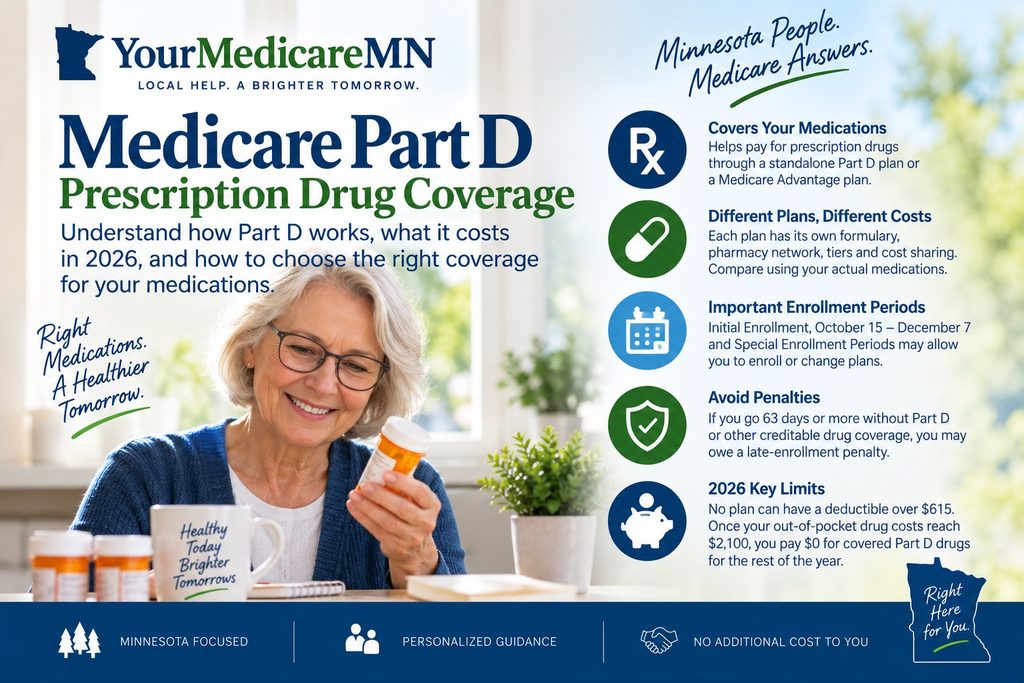
$615
A plan can have a lower deductible or no deductible.
A plan may also apply its deductible differently to different drug tiers according to Medicare rules and the plan’s approved benefit design.
Always review the specific plan.
How Does Part D Work in 2026?
The Part D benefit changed substantially beginning in 2025 and continues under the redesigned structure in 2026.
For most beneficiaries, it can be understood in three stages.
1. Deductible Stage
If your plan has a deductible, you generally pay applicable covered prescription costs until the plan’s deductible has been met.
No Part D plan may have a deductible greater than $615 in 2026.
Some plans have no deductible.
2. Initial Coverage Stage
After the applicable deductible is met, you pay the cost sharing established by your plan.
Under the defined standard benefit, beneficiary cost sharing is generally 25% during this stage.
Your actual plan may use copayments or other Medicare-approved cost-sharing arrangements.
3. Catastrophic Coverage
Once your qualifying out-of-pocket spending on covered Part D drugs reaches $2,100 in 2026, you enter catastrophic coverage.
At that point:
You pay $0 for covered Part D drugs for the rest of the calendar year.
Is There Still a Medicare Part D Donut Hole?
The old “coverage gap” or “donut hole” is no longer the correct way to describe the Part D benefit in 2026.
Under the redesigned Medicare Part D structure, the benefit is generally described using:
- Deductible stage
- Initial coverage stage
- Catastrophic coverage stage
For 2026, the annual Part D out-of-pocket threshold is $2,100.
Once you reach that threshold for qualifying covered Part D drug spending, you don’t pay additional out-of-pocket costs for covered Part D drugs for the remainder of the calendar year.
What Counts Toward the $2,100 Part D Limit?
The $2,100 figure applies to qualifying out-of-pocket spending for covered Part D drugs.
Not every payment you make necessarily counts.
For example, your monthly Part D plan premium isn’t simply added to the $2,100 threshold.
Certain payments made on your behalf may count under Medicare’s rules.
Your plan’s Explanation of Benefits tracks your drug spending and shows your progress through the Part D benefit stages.
Does the $2,100 Part D Limit Include Medical Expenses?
No.
The Part D $2,100 out-of-pocket threshold is for qualifying spending on covered Part D prescription drugs.
It isn’t the same as:
- Original Medicare Part A costs
- Original Medicare Part B costs
- A Medicare Advantage plan’s medical maximum out-of-pocket limit
Medical and prescription drug cost limits are governed by different Medicare rules.
What Is the Medicare Prescription Payment Plan?
All Medicare drug plans offer the Medicare Prescription Payment Plan.
This program allows you to spread certain out-of-pocket prescription drug costs over the remaining months of the calendar year rather than paying the entire amount at the pharmacy when you fill the prescription.
This can help some people manage monthly cash flow.
But an important distinction is:
The Medicare Prescription Payment Plan does not lower your drug costs.
It changes when you pay, not the total amount you owe.
Your annual covered Part D drug spending remains subject to the applicable $2,100 out-of-pocket threshold for 2026.
What Is Creditable Prescription Drug Coverage?
Creditable prescription drug coverage is drug coverage that’s expected to pay, on average, at least as much as Medicare’s standard prescription drug coverage.
Examples can include qualifying prescription coverage from:
- A current or former employer
- A union
- TRICARE
- The Department of Veterans Affairs
- Indian Health Service
Your other coverage should notify you whether its prescription drug coverage is considered creditable.
Keep those notices.
They can be important if Medicare later asks you to prove that you maintained creditable prescription coverage.
What Is the Part D Late-Enrollment Penalty?
You may owe a Part D late-enrollment penalty if, after your applicable Initial Enrollment Period, you go 63 consecutive days or more without:
- Medicare prescription drug coverage, or
- Other creditable prescription drug coverage.
The penalty is generally calculated as:
1% of the national base beneficiary premium × the number of full uncovered months
For 2026, the national base beneficiary premium used for this calculation is:
$38.99
The result is rounded to the nearest 10 cents and added to your monthly Part D premium.
The penalty generally continues for as long as you have Medicare drug coverage.
Example of a Part D Late-Enrollment Penalty
Suppose someone went 14 full months without Part D or other creditable prescription drug coverage after becoming eligible.
For 2026:
$38.99 × 14% = $5.46
Rounded to the nearest 10 cents, the monthly penalty would be approximately:
$5.50 per month
That amount would be added to the person’s Part D premium for 2026.
This is an example.
The national base beneficiary premium can change each year, so the actual dollar amount of an existing penalty may also change.
What Is Part D IRMAA?
Some higher-income Medicare beneficiaries pay an additional amount for Part D.
This is called the Income-Related Monthly Adjustment Amount, or IRMAA.
IRMAA is separate from the premium charged by your Part D plan.
Social Security generally determines whether IRMAA applies using income information supplied by the IRS.
For 2026, Social Security generally uses the most recent federal income-tax return supplied by the IRS, usually the 2024 tax return filed in 2025.
If income has decreased because of certain qualifying life-changing events, you may be able to ask Social Security to reconsider the IRMAA determination.
What Is Extra Help?
Extra Help is a federal program that helps qualifying Medicare beneficiaries with Part D prescription drug costs.
For qualifying beneficiaries, Extra Help can reduce:
- Plan premiums
- Deductibles
- Copayments
- Coinsurance
People receiving Extra Help don’t pay a Part D late-enrollment penalty.
For 2026, qualifying beneficiaries receiving Extra Help can have substantially reduced prescription costs, subject to the program’s rules.
Because eligibility is based on income and resources and can change, use current Medicare or Social Security information to determine whether you qualify.
Does Part D Cover Vaccines?
Part D covers many vaccines.
Medicare Part D provides $0 cost sharing for adult vaccines recommended by the Advisory Committee on Immunization Practices when those vaccines are covered under Part D.
This includes certain vaccines that aren’t covered under Medicare Part B.
Which part of Medicare covers a vaccine depends on the vaccine.
What About Insulin in 2026?
Medicare continues to limit beneficiary cost sharing for covered insulin products.
Beginning in 2026, the monthly amount for each covered insulin product is generally capped at the lowest applicable amount under Medicare’s statutory formula, which includes a $35 maximum.
Because negotiated drug prices can affect the calculation for individual insulin products beginning in 2026, check the specific plan and insulin product rather than assuming every insulin prescription will cost exactly $35.
When Can You Enroll in or Change Part D Coverage?
You generally can’t join or change a Medicare drug plan whenever you want.
Medicare establishes specific enrollment periods.
Initial Enrollment Period
When you’re first eligible for Medicare, you generally have an Initial Enrollment Period in which you can enroll in Medicare prescription drug coverage.
If you’re enrolling in a standalone Part D plan, you need Medicare Part A and/or Part B.
Medicare Open Enrollment: October 15–December 7
Each year, Medicare Open Enrollment runs:
October 15 through December 7
During this period, eligible beneficiaries can:
- Join a Medicare drug plan
- Switch Medicare drug plans
- Drop Medicare drug coverage
- Make applicable Medicare Advantage changes involving prescription drug coverage
Changes made during this period generally become effective January 1 of the following year when the enrollment request is received by December 7.
Special Enrollment Periods
Certain circumstances can give you a Special Enrollment Period outside Medicare Open Enrollment.
For example, if you involuntarily lose creditable prescription drug coverage, you generally have an opportunity to enroll in Medicare drug coverage.
The exact enrollment period depends on the qualifying event.
Don’t assume that every loss of coverage creates the same deadline.
What Happens If You Lose Creditable Drug Coverage?
If you involuntarily lose other creditable prescription drug coverage, or the coverage changes and is no longer creditable, Medicare generally provides a Special Enrollment Period.
The opportunity generally lasts for 2 full months after the month you lose the creditable coverage or 2 full months after you’re notified that the coverage is no longer creditable, whichever is later.
This is one reason to keep documentation showing whether employer, union or other prescription coverage was creditable.
Part D and Employer or Union Coverage
Be especially careful before enrolling in Medicare drug coverage if you have employer or union health coverage.
Enrolling in Part D can sometimes affect:
- Your own employer coverage
- Your spouse’s coverage
- Dependent coverage
- Employer or union prescription benefits
Medicare specifically recommends checking with your benefits administrator before changing coverage.
Don’t drop employer or union prescription coverage solely because you’re Medicare-eligible without first understanding the consequences.
Part D and VA or TRICARE Coverage
VA and TRICARE prescription coverage may qualify as creditable coverage.
However, Medicare drug coverage can interact differently with each program.
Before changing VA, TRICARE or other federal prescription coverage, check the applicable program’s rules.
The fact that coverage is creditable doesn’t necessarily mean adding Medicare Part D will improve your overall coverage.
Part D and Medicare Supplement Insurance in Minnesota
Medicare Supplement insurance and Medicare Part D serve different purposes.
A Minnesota Medicare Supplement policy is designed to supplement certain Original Medicare Part A and Part B costs.
Part D is the Medicare program for outpatient prescription drug coverage.
Don’t assume that purchasing a Minnesota Medicare Supplement policy automatically gives you comprehensive outpatient prescription drug coverage.
If you use Original Medicare and want Medicare prescription drug coverage, evaluate Part D separately.
Minnesota Medicare Supplement insurance is standardized differently from most states, so Minnesota-specific information should be used when evaluating Supplement coverage.
Part D Plans Can Change Every Year
Medicare Part D plans can make changes from one year to another within Medicare requirements.
Changes can include:
- Monthly premium
- Deductible
- Copayments
- Coinsurance
- Formulary
- Drug tiers
- Pharmacy network
- Preferred pharmacies
- Prior authorization
- Step therapy
- Quantity limits
Don’t assume that because your medications were covered favorably this year, they’ll be covered in the same way next year.
Review your plan information annually.
Review Your Annual Notice of Change
If you’re enrolled in Medicare drug coverage, your plan sends information describing changes for the following plan year.
Review changes affecting:
- Your medications
- Drug tiers
- Prescription costs
- Pharmacy network
- Deductible
- Premium
- Coverage restrictions
A plan that was a good fit this year may not remain the best fit next year.
How Should You Compare Medicare Part D Plans?
Don’t choose a Part D plan based solely on its premium.
Compare:
Your Medications
Are all of your prescriptions on the plan’s formulary?
Drug Tiers
Which tier contains each medication?
Total Estimated Annual Cost
Consider premiums and expected prescription spending together.
Pharmacy
Is your preferred pharmacy in the plan’s network?
Is it preferred or standard?
Coverage Restrictions
Does the plan require prior authorization, step therapy or quantity limits?
Deductible
Does the plan have a deductible, and how does it apply to your medications?
Mail Order
Would mail-order pharmacy services be useful for your prescriptions?
Other Coverage
Could enrolling affect employer, union, VA, TRICARE or other coverage?
The lowest-premium plan isn’t necessarily the lowest-cost plan for your particular prescriptions.
Medicare Part D: Important 2026 Numbers
| Part D item | 2026 amount |
|---|---|
| Maximum plan deductible | $615 |
| Annual Part D out-of-pocket threshold | $2,100 |
| Covered Part D drugs after threshold | $0 beneficiary cost sharing |
| National base beneficiary premium used for penalty | $38.99 |
| General late penalty calculation | 1% per full uncovered month |
| Uncovered period that can trigger penalty | 63 consecutive days or more |
Plan premiums and individual prescription costs vary.
These figures apply to 2026 and should be rechecked for future plan years.
What Should Minnesota Medicare Beneficiaries Remember About Part D?
The key points are:
- Part D helps pay for prescription drugs.
- You can obtain it through a standalone Medicare drug plan or through many Medicare Advantage plans.
- Plans have different formularies and pharmacy networks.
- The maximum Part D deductible is $615 in 2026.
- The 2026 out-of-pocket threshold for covered Part D drugs is $2,100.
- After reaching the applicable threshold, you pay $0 for covered Part D drugs for the rest of the calendar year.
- The old “donut hole” terminology doesn’t accurately describe the current 2026 Part D benefit structure.
- Going 63 days or more without Part D or other creditable prescription drug coverage can trigger a late-enrollment penalty.
- Employer, union, VA and TRICARE coverage should be reviewed before making Part D changes.
- Your plan’s formulary, drug tiers, pharmacy network and costs should be reviewed every year.
YourMedicareMN can help you choose the right prescription drug plan and review all Minnesota-specific options.
📞 952-201-5991
📍 Serving all of Minnesota
💻 Phone and virtual appointments available
Visit Contact Us to schedule a personalized Medicare review and get answers tailored to your situation.
For official Medicare information, visit the Medicare.gov website.