
Your Medicare plan may cover your prescriptions in 2027, but will you pay the same amount for them?
Not necessarily.
Medicare prescription drug plans can change their covered medications, drug tiers, pharmacy networks, deductibles and cost-sharing from year to year.
A prescription that was affordable in 2026 could cost more in 2027. Another plan might cover that same medication at a lower cost.
With Medicare’s Annual Enrollment Period running October 15 through December 7, 2026, now is the time to review your prescription drug coverage for next year.
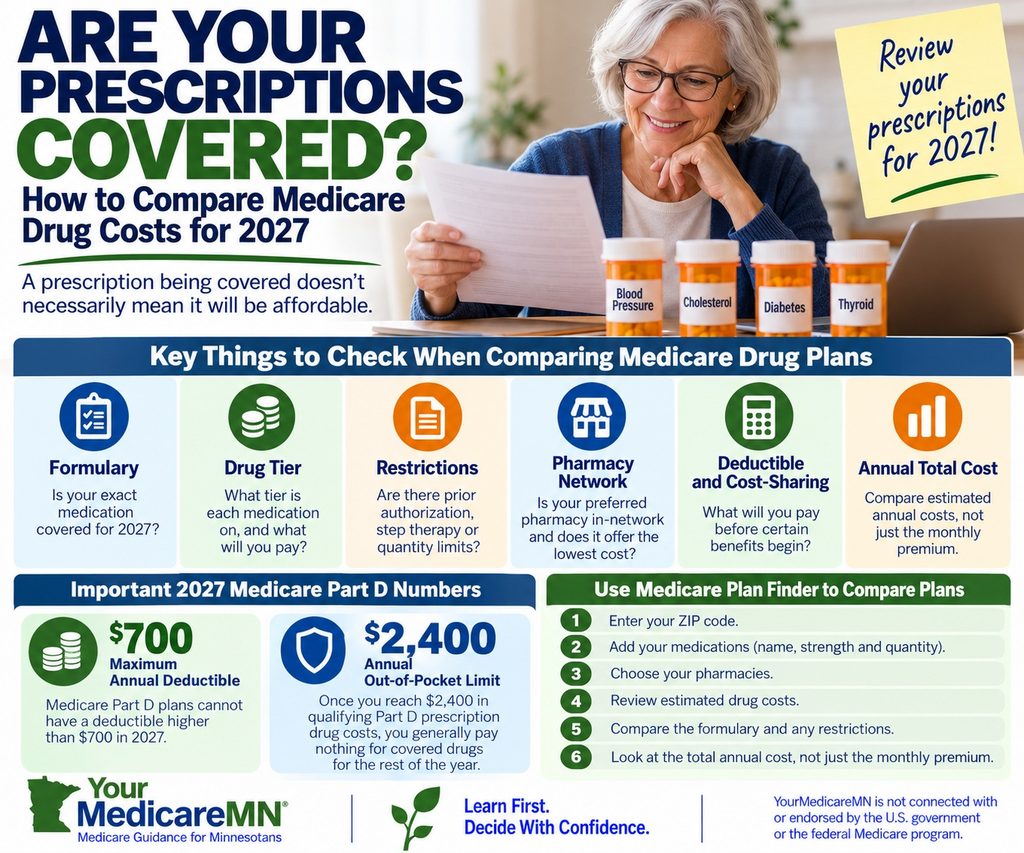
Here’s how to compare Medicare drug costs and avoid some common mistakes.
1. Start With a Complete List of Your Prescriptions
Before comparing Medicare plans, make a list of every prescription medication you currently take.
Include:
- Medication name
- Dosage or strength
- Quantity
- How often you take it
- Whether you use the brand-name or generic version
- Your preferred pharmacy
For example, don’t simply enter the name of a medication without checking the dosage and quantity.
Different strengths, formulations and quantities may have different coverage or costs.
The more accurate your medication list, the more useful your Medicare plan comparison will be.
If you’re uncertain about the details, review your prescription labels or ask your pharmacist for a current medication list.
2. Check Whether Each Medication Is on the Plan’s Formulary
A formulary is a Medicare prescription drug plan’s list of covered medications.
Every Medicare prescription drug plan has a formulary.
But different plans can cover different medications.
For each medication you take, ask:
Is this exact medication covered by the plan for 2027?
Don’t assume a medication is covered simply because it was covered in 2026.
Also, don’t assume two plans offered by the same insurance company use identical formularies.
If a medication doesn’t appear on a plan’s formulary, contact the plan to verify its status and ask about alternatives, transition coverage or the coverage determination and exception process.
Important: A medication being on the formulary doesn’t necessarily mean it will be inexpensive.
That brings us to drug tiers.
3. Understand Medicare Prescription Drug Tiers
Medicare prescription drug plans commonly organize covered medications into tiers.
A tier helps determine how much you may pay for a medication.
A typical formulary might include:
| Drug tier | Common description |
|---|---|
| Tier 1 | Preferred generic medications |
| Tier 2 | Other generic medications |
| Tier 3 | Preferred brand-name medications |
| Tier 4 | Nonpreferred medications |
| Tier 5 | Specialty medications |
This is an example, not a universal Medicare tier structure. Plans can use different numbers of tiers and different tier descriptions.
A medication might be Tier 3 under one plan and Tier 4 under another.
That difference could affect your costs.
But the tier number alone doesn’t tell you exactly what you’ll pay.
Some plans use fixed copays. Others use coinsurance, which is a percentage of the medication’s applicable cost.
You need to compare the actual estimated cost of each prescription.
4. Check for Prescription Drug Restrictions
Even when a medication is covered, a plan may have additional requirements.
Three common restrictions are:
Prior authorization
The plan may require approval before covering a medication.
Step therapy
The plan may require you to try another medication first, subject to applicable exceptions.
Quantity limits
The plan may limit the amount of medication covered within a specified period.
These requirements can affect access to your medications.
If you take a medication that requires prior authorization or has another restriction, understand the plan’s requirements before enrolling.
Don’t assume that an authorization granted by your current plan will automatically transfer to a different plan.
5. Compare Pharmacy Networks and Costs
Here’s something many Medicare beneficiaries overlook:
The same prescription can cost different amounts at different pharmacies under the same Medicare drug plan.
Medicare prescription drug plans may have:
- Preferred network pharmacies
- Standard network pharmacies
- Mail-order pharmacy options
- Out-of-network pharmacies, where coverage may be limited
For example, a plan might offer lower cost-sharing at one pharmacy than another.
If you prefer Walgreens, CVS, Walmart, a local independent pharmacy or another pharmacy, check how that specific location participates in each plan’s 2027 network.
A pharmacy being in-network does not necessarily mean it offers the plan’s lowest cost-sharing.
When comparing plans, review estimated costs using the pharmacies you would actually use.
Also check whether a 90-day supply or mail-order option could change your costs.
6. Understand the Medicare Part D Changes for 2027
There are two important Medicare prescription drug cost figures for 2027.
| Medicare Part D feature | 2026 | 2027 |
|---|---|---|
| Maximum annual deductible | $615 | $700 |
| Annual out-of-pocket threshold | $2,100 | $2,400 |
The maximum deductible is $700
For 2027, Medicare Part D plans cannot have a deductible higher than $700.
However, this does not mean every plan has a $700 deductible.
Some plans may have lower deductibles or no deductible. Plans may also apply deductibles differently to certain medications.
Check the deductible for each plan you’re considering.
The annual out-of-pocket threshold is $2,400
For 2027, the Medicare Part D annual out-of-pocket threshold increases to $2,400.
Once you reach the threshold, you generally pay nothing for covered Part D drugs for the remainder of the calendar year.
However, the threshold does not include every prescription-related expense.
For example, monthly plan premiums, spending on medications not covered under Part D and certain other payments do not count toward the threshold.
Certain payments made on your behalf may count, even if you didn’t personally pay those amounts.
The $2,400 limit applies to qualifying Medicare Part D prescription drug spending. It is not a limit on all healthcare expenses.
Medicare Advantage plans have separate maximum out-of-pocket limits for covered Medicare Part A and Part B services.
7. Compare Estimated Annual Costs, Not Just Monthly Premiums
Suppose you’re comparing two Medicare prescription drug plans.
One has a relatively low monthly premium but higher costs for your medications.
Another has a higher premium but more favorable coverage for the prescriptions you take.
Which is less expensive?
You won’t know by comparing premiums alone.
A useful comparison includes:
Annual plan premiums + estimated prescription drug out-of-pocket costs = estimated annual prescription coverage cost
For example, consider this hypothetical comparison:
| Cost | Plan A | Plan B |
|---|---|---|
| Monthly premium | $10 | $35 |
| Annual premiums | $120 | $420 |
| Estimated annual drug out-of-pocket costs | $1,200 | $500 |
| Estimated combined annual cost | $1,320 | $920 |
In this example, Plan B has the higher monthly premium but the lower estimated combined annual cost.
These numbers are illustrative only and do not represent actual 2027 Medicare plans.
The lesson is simple:
The prescription drug plan with the lowest premium isn’t necessarily the plan with the lowest overall cost.
8. Use Medicare Plan Finder to Compare Your Actual Medications
One of the most useful tools for comparing Medicare prescription drug costs is Medicare’s official Plan Finder.
Visit: https://www.medicare.gov/plan-compare
Here’s how to use it.
Step 1: Enter your ZIP code.
Medicare Plan Finder will identify plans available where you live.
Step 2: Select the type of coverage you want to compare.
You can compare standalone Medicare prescription drug plans or Medicare Advantage plans that include prescription drug coverage.
Step 3: Enter your medications.
Include the correct names, strengths, quantities and refill frequencies.
Step 4: Select your pharmacies.
Choose the pharmacies you actually use, and consider comparing more than one location.
Step 5: Review estimated annual drug costs.
Look beyond the monthly premium and examine the estimated costs for your prescriptions.
Step 6: Review the plan’s formulary and restrictions.
Check whether every medication is covered and whether prior authorization, step therapy or quantity limits apply.
Step 7: Compare the complete Medicare coverage arrangement.
If you’re evaluating Medicare Advantage plans, don’t select a plan based only on prescription costs.
You also need to consider your doctors, hospitals, medical cost-sharing, provider networks and other benefits.
Medicare Plan Finder provides estimates based on available plan information and the medications and pharmacies you enter. Actual costs can vary.
9. What if Your Medication Isn’t Covered?
If a Medicare prescription drug plan doesn’t cover a medication you take, don’t immediately assume you must stop taking it.
You may have options.
Depending on the circumstances, these could include:
- Asking your prescriber about a covered alternative
- Requesting a formulary exception
- Requesting an exception to certain coverage restrictions
- Reviewing applicable transition-fill protections
- Comparing another Medicare plan that covers the medication
Your prescriber can help determine whether a covered alternative is medically appropriate.
Never stop or change a prescribed medication solely because of a formulary listing without consulting your healthcare professional.
10. Don’t Overlook Extra Help and the Medicare Prescription Payment Plan
Two programs may be worth reviewing.
Extra Help
Medicare’s Extra Help program assists eligible people with limited income and resources in paying certain Medicare prescription drug costs.
Depending on eligibility, assistance may include premiums, deductibles and prescription cost-sharing.
You can learn more through Medicare.gov or the Social Security Administration.
Medicare Prescription Payment Plan
The Medicare Prescription Payment Plan allows people with Medicare Part D coverage to spread their qualifying out-of-pocket prescription drug costs across monthly payments during the calendar year.
This can help with budgeting, especially when prescription costs are higher early in the year.
However, the Medicare Prescription Payment Plan does not lower the total cost of your prescriptions.
It changes when you pay those costs.
Ask your Medicare drug plan how participation works for 2027.
11. What if You Have Veterans Affairs or Employer Prescription Coverage?
Not everyone with Medicare needs a standalone Medicare prescription drug plan.
Some beneficiaries have prescription drug coverage through:
- Veterans Affairs
- Current or former employers
- Unions
- Other qualifying sources
Before enrolling in or dropping Medicare prescription drug coverage, determine whether your existing coverage is creditable.
Also consider whether enrolling in Medicare Part D could affect other health or prescription benefits.
Don’t drop employer, retiree or other prescription coverage without understanding the consequences.
12. When Can You Change Medicare Prescription Drug Plans for 2027?
Medicare’s Annual Enrollment Period runs from:
October 15 through December 7, 2026.
During this period, eligible beneficiaries can generally change their Medicare prescription drug coverage for the following year.
Changes generally take effect January 1, 2027.
If your current plan is continuing and its prescription coverage still meets your needs, you generally don’t have to change plans.
However, you should review your Annual Notice of Change and confirm how your medications will be covered in 2027.
If your plan is ending, follow the instructions in the notice you receive and review your available options.
Seven Questions to Ask Before Choosing Prescription Drug Coverage
Before deciding on Medicare prescription drug coverage for 2027, ask:
- Are all my medications covered?
- What tier is each medication on?
- Are there prior authorization, step therapy or quantity restrictions?
- Is my preferred pharmacy in-network, and does it offer preferred cost-sharing?
- What deductible applies to my medications?
- What are my estimated total annual premiums and prescription costs?
- If I’m considering Medicare Advantage, does the entire plan meet my healthcare needs?
These questions can help you compare prescription drug coverage more effectively.
The Bottom Line
When reviewing Medicare prescription drug coverage for 2027, don’t stop at asking:
“Is my medication covered?”
Ask:
“How is my medication covered, where can I fill it, and what will it actually cost?”
Compare formularies, drug tiers, restrictions, pharmacy networks, deductibles and estimated annual costs.
And remember that a plan with a lower premium may not be the least expensive option overall.
The goal isn’t simply to find another Medicare plan.
It’s to understand your coverage and make an informed decision based on your medications, healthcare needs and budget.
Medicare Guidance for Minnesotans
At YourMedicareMN, our focus is education first.
We help Minnesota Medicare beneficiaries understand prescription drug coverage, review annual changes and compare Medicare options based on their individual needs.
At YourMedicareMN, we believe education comes before enrollment.
Visit Contact Us to schedule a personalized Medicare review and get answers tailored to your situation.
For official Medicare information, visit the Medicare.gov website.
YourMedicareMN is not connected with or endorsed by the U.S. government or the federal Medicare program. Plan availability and benefits vary by location and plan. Contact the plan or Medicare for complete plan information.
Learn First. Decide With Confidence.
YourMedicareMN
Medicare Guidance for Minnesotans