
If you’re comparing Medicare Advantage plans for 2027, you’ve probably noticed that many plans include the letters HMO or PPO after their names.
What do those letters mean?
And more importantly, how could they affect your doctors, hospitals, healthcare costs and ability to receive care when you’re away from home?
Understanding the difference between a Health Maintenance Organization (HMO) and a Preferred Provider Organization (PPO) is an important part of comparing Medicare Advantage coverage.
Both are types of Medicare Advantage plans, but they generally have different rules about provider networks, referrals and out-of-network care.
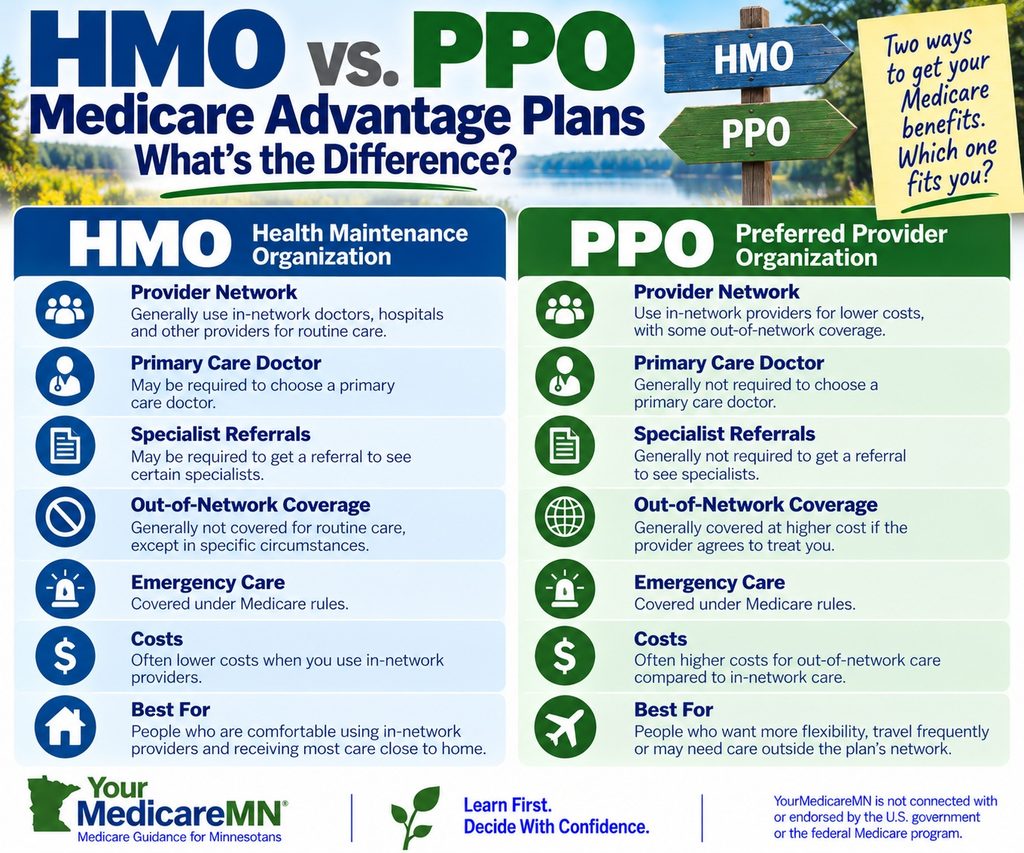
Here’s what Minnesota Medicare beneficiaries should know.
What Is a Medicare Advantage Plan?
Medicare Advantage, also called Medicare Part C, is an alternative way to receive your Medicare Part A and Part B benefits through a Medicare-approved private insurance company.
Medicare Advantage plans must cover all medically necessary services that Original Medicare covers, except hospice care, which Original Medicare generally continues to cover.
Many Medicare Advantage plans also include Medicare Part D prescription drug coverage and may offer supplemental benefits such as dental, vision, hearing or fitness programs.
However, Medicare Advantage plans can have different:
- Provider networks
- Copays and coinsurance
- Deductibles
- Maximum out-of-pocket limits
- Referral requirements
- Prior authorization requirements
- Prescription drug coverage
- Supplemental benefits
Two common Medicare Advantage plan types are HMOs and PPOs.
What Is an HMO Medicare Advantage Plan?
HMO stands for Health Maintenance Organization.
An HMO Medicare Advantage plan generally requires you to receive non-emergency healthcare from doctors, hospitals and other providers within the plan’s network.
The network is a group of healthcare providers that have agreements with the insurance company.
How an HMO Typically Works
With an HMO Medicare Advantage plan:
- You generally use in-network providers for routine healthcare.
- You may need to select a primary care doctor.
- You may need referrals to see certain specialists.
- Non-emergency out-of-network care generally isn’t covered, except in specific circumstances.
- Emergency care and certain other services have special coverage protections.
Some Medicare Advantage HMO plans have a Point-of-Service (HMO-POS) feature that allows certain out-of-network services, usually with different costs or restrictions.
Because HMO rules vary, review the specific plan’s Evidence of Coverage before enrolling.
Example of an HMO
Suppose you live in Minnesota and your primary care doctor, specialists and preferred hospital all participate in an HMO plan’s network.
If you receive most of your healthcare locally and are comfortable using those providers, an HMO may meet your needs.
However, if you want routine care from a specialist outside the network, you may have limited coverage unless the plan has a specific exception or out-of-network benefit.
The important question is whether the HMO’s network includes the providers you want to use.
What Is a PPO Medicare Advantage Plan?
PPO stands for Preferred Provider Organization.
A PPO Medicare Advantage plan generally gives you more flexibility to receive covered healthcare from providers outside the plan’s network.
However, that flexibility often comes with higher costs.
How a PPO Typically Works
With a PPO Medicare Advantage plan:
- You generally pay less when using in-network providers.
- You can usually receive covered services from out-of-network providers who agree to treat you under the plan’s terms.
- Out-of-network care generally costs more.
- You typically don’t need referrals to see specialists.
- You aren’t generally required to select a primary care doctor.
Some PPO plans have separate in-network and combined in-network/out-of-network maximum out-of-pocket limits.
A PPO’s out-of-network benefits can be useful, but they don’t mean every provider will agree to treat you.
Example of a PPO
Suppose you live in northern Minnesota but occasionally receive specialized healthcare in the Twin Cities.
A PPO might allow you to receive covered services from an out-of-network specialist, provided the specialist agrees to treat you under the plan’s terms.
However, you may pay higher copays or coinsurance than you would with an in-network provider.
A PPO provides greater flexibility, but it doesn’t guarantee that every doctor or hospital will accept the plan.
HMO vs. PPO Medicare Advantage: Side-by-Side Comparison
| Feature | HMO | PPO |
|---|---|---|
| Provider network | Generally required for routine care | In-network preferred, with some out-of-network coverage |
| Primary care doctor | May be required | Generally not required |
| Specialist referrals | May be required | Generally not required |
| Routine out-of-network care | Generally not covered, with exceptions | Generally covered at higher cost if the provider agrees to treat you |
| Emergency care | Covered under Medicare rules | Covered under Medicare rules |
| Travel flexibility | Routine care may be more limited | May offer more options for routine care |
| Monthly premium | Varies by plan | Varies by plan |
| Maximum out-of-pocket limit | Required | Required; may include separate network limits |
| Prescription drug coverage | Often included | Often included |
Important: This table describes typical Medicare Advantage HMO and PPO characteristics. Individual plans can have different rules, exceptions and benefits.
1. Provider Networks: One of the Biggest Differences
Provider networks are often the most important distinction between HMO and PPO Medicare Advantage plans.
With an HMO, you generally need to receive routine healthcare from providers within the plan’s network.
With a PPO, you generally have the option to receive covered services outside the network, although your costs may be higher.
But here’s something important:
Being able to use out-of-network providers doesn’t mean every provider will accept your PPO plan.
Before enrolling, verify your preferred doctors, specialists, hospitals and healthcare systems.
Don’t simply ask whether a provider accepts Medicare.
Instead ask:
“Are you in-network for this specific Medicare Advantage plan for 2027?”
For PPO out-of-network care, also confirm that the provider is willing to treat you under the plan’s terms.
2. Specialist Referrals: Do You Need Permission?
Some HMO plans require a referral from your primary care doctor before you see certain specialists.
PPO plans generally don’t require specialist referrals.
For example, if you need to see a cardiologist or orthopedic specialist, a PPO may allow you to schedule an appointment without first obtaining a referral.
However, a referral and prior authorization are not the same thing.
A referral typically comes from a healthcare provider directing you to another provider.
Prior authorization is approval from the insurance plan for certain services or treatments.
Both HMO and PPO plans may require prior authorization for certain services.
Always review the specific plan’s rules.
3. Out-of-Network Coverage: What Happens if Your Doctor Isn’t in the Network?
This is a critical question.
With an HMO
Routine out-of-network healthcare is generally not covered unless an exception applies or the plan includes an out-of-network benefit.
You could be responsible for the full cost of noncovered services.
With a PPO
Covered out-of-network healthcare is generally available, but you will often pay more than you would for in-network care.
For example, a PPO might charge one amount for an in-network specialist visit and a higher amount for an out-of-network visit.
The actual costs depend on the plan.
Don’t assume that out-of-network coverage means the same costs or access as in-network care.
4. HMO vs. PPO Costs: Which Is Less Expensive?
There’s no universal answer.
An HMO may have lower premiums or cost-sharing than a PPO, but that isn’t always the case.
When comparing plans, consider:
- Monthly premiums
- Primary care copays
- Specialist copays
- Hospital costs
- Outpatient procedure costs
- Deductibles
- Coinsurance
- Maximum out-of-pocket limits
- Prescription drug costs
For PPO plans, pay particular attention to the difference between in-network and out-of-network costs.
A plan with a $0 monthly premium can still have significant healthcare expenses.
And a PPO with greater provider flexibility may not be the least expensive option if you regularly receive out-of-network care.
Compare your potential total healthcare costs, not simply the monthly premium.
5. Maximum Out-of-Pocket Limits: An Important Difference
Medicare Advantage plans must have an annual maximum out-of-pocket limit for qualifying covered Medicare Part A and Part B services.
This limit helps protect beneficiaries from unlimited cost-sharing for those covered medical services.
However, the limits vary by plan.
An HMO generally has a limit applicable to covered in-network medical services.
A PPO may have an in-network limit and a separate combined limit for covered in-network and out-of-network services.
Not every expense counts toward these limits.
For example, monthly plan premiums and Medicare Part D prescription drug costs generally don’t count toward the Medicare Advantage medical maximum out-of-pocket limit.
When comparing an HMO and PPO, look carefully at the plan’s maximum out-of-pocket limits and what expenses count toward them.
6. Travel: Which Plan Works Better Away From Home?
Travel is another important consideration, especially for Minnesota residents who spend part of the year in another state.
Perhaps you spend winters in Arizona or Florida.
Or maybe you regularly travel between northern Minnesota and the Twin Cities.
Both HMO and PPO Medicare Advantage plans must provide applicable coverage for emergency and urgently needed services.
However, routine healthcare away from home can be different.
An HMO may have limited coverage for routine out-of-network care.
A PPO may offer greater flexibility for covered routine services outside its network, subject to the plan’s rules and provider willingness.
Some plans also offer special travel-related benefits.
Don’t assume that a PPO automatically provides unrestricted healthcare access anywhere in the country.
If you travel frequently, check how the plan handles routine healthcare outside your home area.
7. Prescription Drug Coverage: Does HMO or PPO Matter?
Both HMO and PPO Medicare Advantage plans may include Medicare Part D prescription drug coverage.
These plans are often called Medicare Advantage plans with prescription drug coverage.
But drug coverage varies by the specific plan.
Before enrolling, review:
- Covered medications
- Formulary tiers
- Prescription deductibles
- Pharmacy networks
- Preferred pharmacy cost-sharing
- Prior authorization
- Step therapy
- Quantity limits
Don’t assume that two plans from the same insurance company have identical prescription coverage.
And remember that certain Medicare Advantage plans without prescription drug coverage cannot generally be combined with a standalone Medicare Part D plan.
Verify the rules before selecting separate prescription coverage.
Which Is Better: HMO or PPO Medicare Advantage?
Neither plan type is automatically better.
The right choice depends on your doctors, healthcare needs, financial priorities and lifestyle.
An HMO May Be Worth Considering If:
- Your preferred doctors and hospitals are in-network.
- You generally receive healthcare close to home.
- You’re comfortable following the plan’s network and referral rules.
- The plan’s costs and benefits fit your needs.
A PPO May Be Worth Considering If:
- You want greater flexibility in choosing providers.
- You regularly receive healthcare in different locations.
- You want access to covered out-of-network services.
- You prefer not to obtain specialist referrals.
- You’re comfortable with potentially higher out-of-network costs.
These are considerations, not guarantees.
The best choice is based on the specific plan, not simply whether its name includes HMO or PPO.
Important Considerations for Minnesota Medicare Beneficiaries in 2027
Minnesota’s Medicare Advantage market is experiencing significant changes for 2027.
Several insurance companies have discontinued plans, changed service areas or introduced different coverage options.
If your current plan is ending, don’t assume that a replacement plan from the same insurance company will have the same provider network, costs or benefits.
If you’re comparing HMO and PPO plans, check:
1. Plan availability: Is the plan offered where you live?
2. Provider network: Are your doctors, specialists and hospitals in-network?
3. Out-of-network benefits: What services are covered, and at what cost?
4. Prescription coverage: Are your medications covered at acceptable costs?
5. Total healthcare costs: What might you pay in a typical year or a year with significant medical expenses?
6. Travel needs: How does the plan work when you’re away from home?
For Minnesota residents, it’s also important to remember that Medicare Cost Plans are a separate type of Medicare health plan with different rules.
Don’t assume a Medicare Cost Plan works exactly like an HMO or PPO Medicare Advantage plan.
When Can You Switch Medicare Advantage Plans?
Medicare’s Annual Enrollment Period runs from October 15 through December 7, 2026.
During this period, eligible Medicare beneficiaries can switch Medicare Advantage plans or make other permitted coverage changes for 2027.
Changes generally take effect January 1, 2027.
People already enrolled in Medicare Advantage may also have certain options during the Medicare Advantage Open Enrollment Period from January 1 through March 31.
Special Enrollment Periods may apply in other circumstances.
How to Compare HMO and PPO Plans
Medicare’s official Plan Finder can help you compare Medicare Advantage plans available in your area.
Visit:
When comparing plans:
- Enter your ZIP code.
- Review the Medicare Advantage plans available in your area.
- Identify whether each plan is an HMO or PPO.
- Compare premiums, deductibles, copays and maximum out-of-pocket limits.
- Review prescription drug coverage.
- Verify your doctors and hospitals.
- Examine out-of-network rules and costs.
- Consider your healthcare needs and travel patterns.
Don’t select a plan based only on its monthly premium or its HMO or PPO designation.
The Bottom Line
The biggest difference between HMO and PPO Medicare Advantage plans generally involves provider networks and out-of-network coverage.
An HMO typically emphasizes receiving routine care within its provider network.
A PPO generally offers greater flexibility to receive covered care outside its network, often at a higher cost.
But the specific plan matters more than the label.
Before choosing Medicare Advantage coverage for 2027, compare your doctors, hospitals, prescriptions, costs and healthcare needs.
An HMO may work well for one beneficiary, while a PPO may be more appropriate for another.
And if your current coverage continues to meet your needs, changing plans may not be necessary.
The goal isn’t to find the most attractive advertisement or the lowest premium.
It’s to understand your options and make an informed decision.
Learn First. Decide With Confidence.
Medicare Guidance for Minnesotans
At YourMedicareMN, our focus is education first.
We help Minnesota Medicare beneficiaries understand Medicare Advantage plan differences, provider networks, coverage rules and costs so they can evaluate available options based on their individual needs.
At YourMedicareMN, we believe education comes before enrollment.
Visit Contact Us to schedule a personalized Medicare review and get answers tailored to your situation.
For official Medicare information, visit the Medicare.gov website.
YourMedicareMN is not connected with or endorsed by the U.S. government or the federal Medicare program. Plan availability and benefits vary by location and plan. Contact the plan or Medicare for complete plan information.
Learn First. Decide With Confidence.
YourMedicareMN
Medicare Guidance for Minnesotans