
When you’re trying to understand Medicare costs, two words come up again and again:
Copay and coinsurance.
Both describe your share of the cost when you receive healthcare or fill a prescription. But they work differently.
The easiest way to remember the difference is:
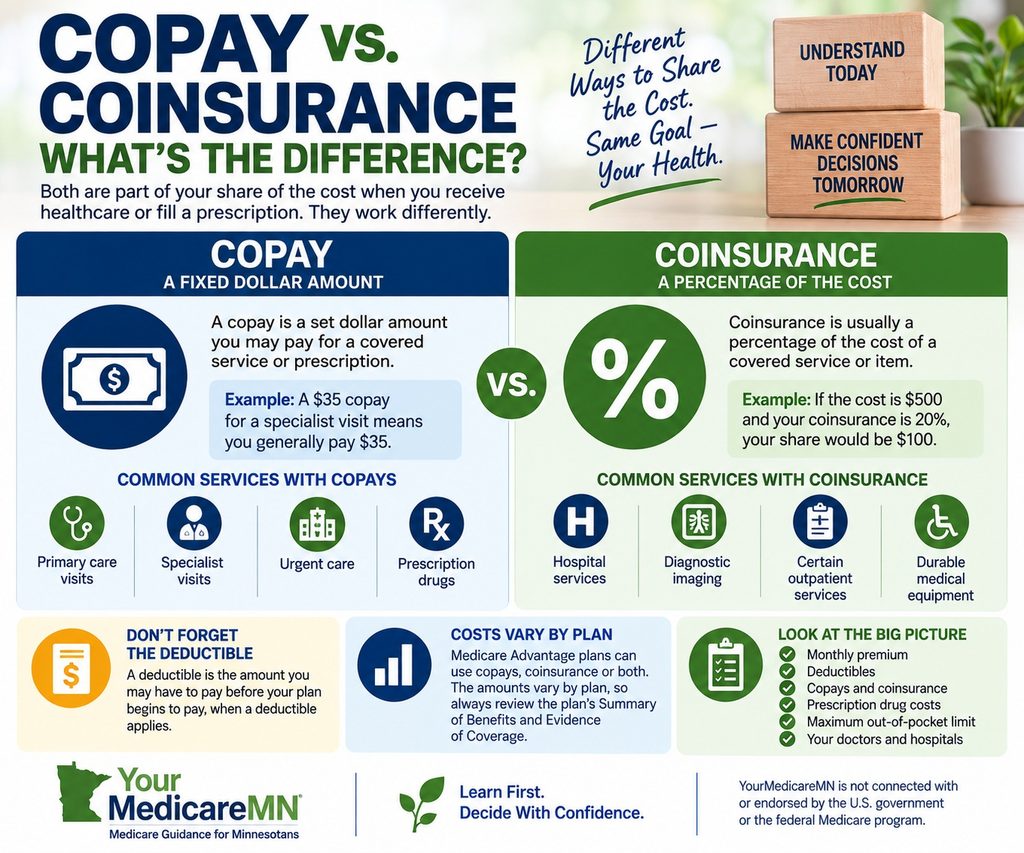
Copay = a fixed dollar amount
Coinsurance = a percentage of the cost
Understanding that distinction can make Medicare plan costs much easier to compare.
What Is a Copay?
A copayment, commonly called a copay, is a fixed dollar amount you may be required to pay as your share of the cost of a covered healthcare service or prescription.
For example, suppose your Medicare Advantage plan says you have a:
$35 specialist copay
If you receive a covered specialist visit and the plan’s rules are met, your share for that visit would generally be $35.
The important part is that the copay is expressed as a dollar amount.
Depending on the plan, you might encounter copays for services such as:
- Primary care visits
- Specialist visits
- Urgent care
- Emergency room visits
- Hospital services
- Physical therapy
- Prescription drugs
The actual copay depends on your plan and the service you receive.
What Is Coinsurance?
Coinsurance is an amount you may be required to pay as your share of the cost of a covered service or item. Unlike a copay, coinsurance is usually expressed as a percentage.
For example:
Suppose the amount used to calculate the cost of a covered service is $500 and your coinsurance is 20%.
Your share would be:
20% of $500 = $100
That’s different from a copay because your dollar cost depends on the amount to which the percentage applies.
Copay vs. Coinsurance: A Simple Example
Imagine two different plans cover the same type of service.
Plan A: $50 copay
Plan B: 20% coinsurance
With Plan A, your cost for that covered service would generally be the fixed $50 copay, subject to the plan’s rules.
With Plan B, you need another piece of information before you know your cost:
20% of what amount?
If the applicable amount were $200, 20% would be $40.
If it were $1,000, 20% would be $200.
That’s why coinsurance can sometimes be more difficult to estimate in advance.
How Does Coinsurance Work With Original Medicare?
Original Medicare frequently uses coinsurance.
For Medicare Part B, after you meet the annual Part B deductible, you generally pay 20% of the Medicare-approved amount for many covered services and items when the provider accepts assignment.
For example, if the Medicare-approved amount for a covered Part B service were $300 and 20% coinsurance applied:
Medicare would generally pay its share, and your 20% share would be:
$60
Not every Medicare service uses the same cost-sharing structure, so don’t assume that 20% applies to every service you receive.
How Do Copays and Coinsurance Work With Medicare Advantage?
Medicare Advantage plans can use both copays and coinsurance.
The exact amounts vary by plan.
A Medicare Advantage plan might use a copay for one type of service and coinsurance for another.
For example, a plan might have:
- A fixed copay for a specialist visit
- A fixed copay for urgent care
- Coinsurance for certain medical equipment
- Coinsurance for some outpatient services
These are examples only. Actual costs depend on the individual plan.
That’s why it’s important to review the specific plan’s Summary of Benefits and Evidence of Coverage rather than assuming all Medicare Advantage plans use the same cost-sharing.
What About Prescription Drugs?
Prescription drug coverage may also use copays or coinsurance.
A copay might require you to pay a fixed dollar amount for a covered medication.
Coinsurance requires you to pay a percentage of the applicable cost.
Your actual prescription costs can depend on several factors, including:
- The drug you’re taking
- Whether the drug is covered by your plan
- The drug’s formulary tier
- The pharmacy you use
- Whether a deductible applies
- The applicable prescription drug coverage rules
For 2026, Medicare drug plans may use copayments and coinsurance as part of their cost-sharing structure.
Where Does the Deductible Fit In?
A deductible is different from both a copay and coinsurance.
A deductible is an amount you must pay for healthcare or prescriptions before Original Medicare, your Medicare Advantage plan, your Medicare drug plan or other insurance begins to pay, when a deductible applies.
So there are three different concepts:
Deductible: An amount you may have to pay before coverage begins paying for certain services or prescriptions.
Copay: A fixed dollar amount you pay as your share of a covered service or prescription.
Coinsurance: Usually a percentage you pay as your share of the cost.
Depending on your coverage, these different forms of cost-sharing can work together.
Why Does the Difference Matter?
Suppose you’re comparing two Medicare Advantage plans.
One plan charges a $45 copay for a particular covered service.
Another charges 20% coinsurance.
You can’t determine which one would cost you less simply by looking at those two numbers.
To understand the coinsurance cost, you need to know the amount the percentage will be based on.
And you shouldn’t compare just one service.
You need to consider the healthcare you actually expect to use.
Pay Particular Attention to Expensive Services
Coinsurance can be especially important when evaluating services with potentially higher costs.
Depending on the plan, coinsurance may apply to services or items such as:
- Diagnostic imaging
- Outpatient procedures
- Certain medical equipment
- Chemotherapy and other Part B drugs
- Other specialized services
If a plan lists a percentage rather than a fixed copay, find out what that percentage is applied to and how the plan calculates your responsibility.
Don’t assume that a percentage automatically means a small dollar amount.
Don’t Compare Medicare Plans on Copays Alone
It’s easy to compare two plans and focus on something obvious such as:
Plan A: $25 specialist copay
Plan B: $40 specialist copay
Plan A appears less expensive for that particular service.
But that doesn’t necessarily mean Plan A will cost less overall.
Plan B might have:
- Lower hospital costs
- Different coinsurance
- A lower maximum out-of-pocket limit
- Better coverage for your prescriptions
- A provider network that better fits your needs
The specialist copay is only one part of the comparison.
Remember the Maximum Out-of-Pocket Limit
Medicare Advantage plans have an annual maximum out-of-pocket limit for covered Medicare Part A and Part B services.
Qualifying copays and coinsurance you pay for covered medical services generally count toward the applicable plan limit.
Once you reach your plan’s applicable limit, you pay nothing for covered Part A and Part B services for the remainder of the calendar year.
The maximum out-of-pocket amount varies by plan.
This is another reason not to evaluate Medicare Advantage coverage based only on individual copays.
Original Medicare Is Different
Original Medicare doesn’t have the same annual maximum out-of-pocket protection for Part A and Part B services that Medicare Advantage plans have.
Under Original Medicare, there is no annual limit on what you could pay out of pocket for covered Part A and Part B services unless you have additional coverage that helps with those expenses.
Some beneficiaries have Medicare Supplement insurance, employer or retiree coverage, Medicaid or other coverage that can help with certain out-of-pocket costs.
Five Questions to Ask When You See a Copay or Coinsurance
When reviewing Medicare coverage, ask:
1. Is this a fixed copay or percentage coinsurance?
Know which type of cost-sharing you’re looking at.
2. If it’s coinsurance, what amount is the percentage based on?
A percentage by itself doesn’t tell you the final dollar cost.
3. Does a deductible apply first?
Find out whether you must satisfy a deductible before the plan begins sharing the cost.
4. Does using an out-of-network provider change the amount?
This can be particularly important with certain Medicare Advantage plans.
5. Does the cost count toward my plan’s maximum out-of-pocket limit?
Understanding your total potential financial exposure can be more useful than looking at a single copay.
Copays and Coinsurance Can Change
If you’re enrolled in a Medicare Advantage or prescription drug plan, don’t assume this year’s copays and coinsurance will automatically remain the same next year.
Plan costs can change from year to year.
Review your plan’s Annual Notice of Change each fall to see what’s changing for the coming year.
Then compare those changes with the healthcare services and prescriptions you actually use.
The Bottom Line
The difference between a copay and coinsurance is simple:
Copay = fixed dollar amount
Coinsurance = usually a percentage
But understanding what those numbers could mean for your total healthcare costs requires looking at the entire plan.
When comparing Medicare coverage, consider:
- Premiums
- Deductibles
- Copays
- Coinsurance
- Prescription costs
- Provider networks
- Maximum out-of-pocket limits
- The healthcare services you actually use
A Medicare plan isn’t necessarily better because one copay is lower.
The goal is to understand how the plan’s overall costs and coverage fit your healthcare needs.
Medicare Guidance for Minnesotans
At YourMedicareMN, our focus is education first.
We help Minnesota Medicare beneficiaries understand how premiums, deductibles, copays, coinsurance and other Medicare costs work so they can make informed decisions about their coverage.
Visit Contact Us to schedule a personalized Medicare review and get answers tailored to your situation.
For official Medicare information, visit the Medicare.gov website.
YourMedicareMN is not connected with or endorsed by the U.S. government or the federal Medicare program. Plan availability and benefits vary by location and plan. Contact the plan or Medicare for complete plan information.Learn First. Decide With Confidence.