
If you have a Medicare Advantage or Medicare Part D prescription drug plan, you should receive an Annual Notice of Change (ANOC) each fall.
Your ANOC explains what will change in your plan for the upcoming year. Those changes can affect your premiums, out-of-pocket costs, prescription drugs, provider access, and other benefits.
The document can be lengthy, but you don’t necessarily need to read every page from beginning to end. Start by paying particular attention to these five areas.
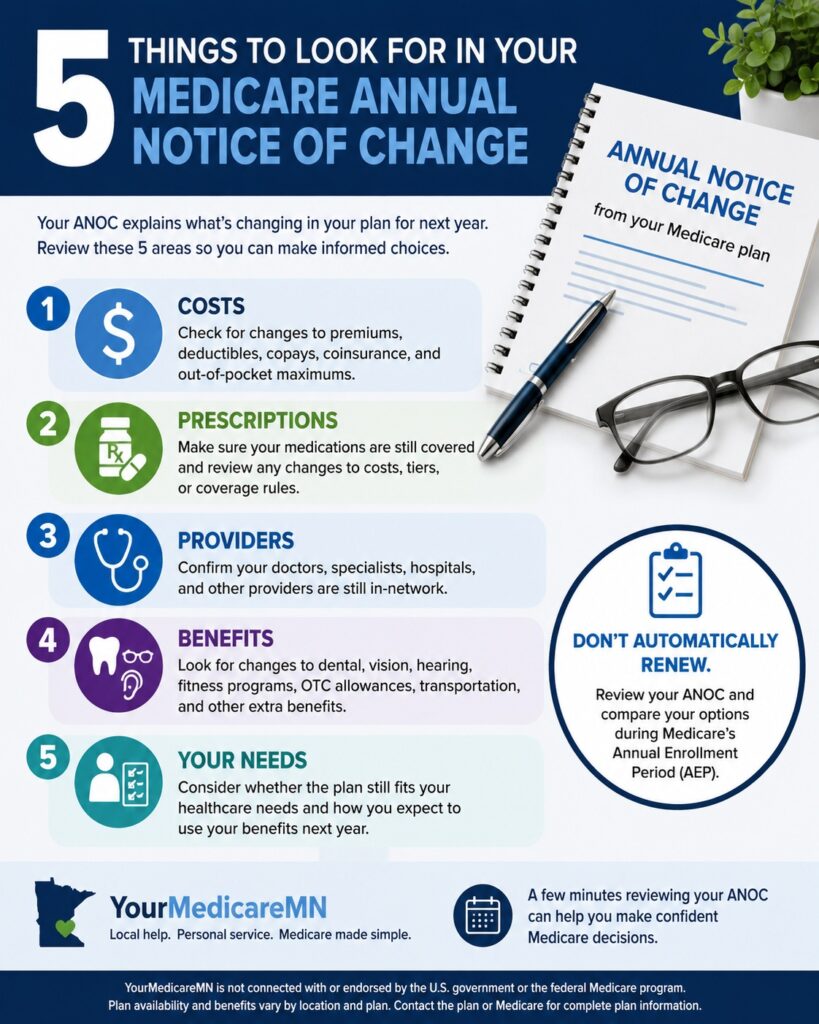
The document can be lengthy, but you don’t necessarily need to read every page from beginning to end. Start by paying particular attention to these five areas.
1. Changes to Your Premiums and Out-of-Pocket Costs
Start with the numbers.
Your ANOC will show whether your plan’s costs are changing for the coming year. Depending on your plan, look for changes to:
- Monthly plan premiums
- Medical deductibles
- Prescription drug deductibles
- Copayments and coinsurance
- Maximum out-of-pocket limits for Medicare Advantage plans
Even relatively small changes can add up over the course of a year, particularly if you regularly see specialists or use other medical services.
Don’t evaluate a Medicare plan based on its monthly premium alone. Your total potential healthcare costs matter.
2. Changes to Prescription Drug Coverage
If your plan includes prescription drug coverage—or you have a stand-alone Medicare Part D plan—this is one of the most important sections to review.
Check whether:
- Your medications are still covered
- Any medications have moved to a different formulary tier
- Your copayments or coinsurance are changing
- Prior authorization is now required
- Step therapy or quantity limits have changed
- Your preferred pharmacies have changed
A plan that worked well for your prescriptions this year may not necessarily be the best fit next year.
When reviewing your coverage, use your current medication list, including dosage and frequency. That provides a much more meaningful comparison than looking at premiums alone.
3. Changes to Your Provider Network
For Medicare Advantage members, provider networks deserve careful attention.
Review whether your:
- Primary care physician
- Specialists
- Hospital or health system
- Clinics
- Other frequently used providers
will continue participating in your plan’s network.
This can be particularly important if you receive ongoing care from a specialist or prefer a particular Minnesota healthcare system.
Remember that provider participation can change. When provider access is important to you, verify participation for the upcoming plan year rather than assuming this year’s network will remain the same.
4. Changes to Additional Benefits
Many Medicare Advantage plans include benefits beyond Original Medicare. Your ANOC may identify changes to benefits such as:
- Dental
- Vision
- Hearing
- Fitness programs
- Over-the-counter allowances
- Transportation
- Other supplemental benefits
Look beyond whether a benefit simply appears on the list.
For example, if dental coverage is important to you, determine whether the amount of coverage, provider requirements, copayments, or covered services are changing.
A benefit may still be offered next year while becoming more limited—or it could become more valuable.
5. Changes That Affect How You Actually Use Your Plan
Finally, consider the ANOC in the context of your own healthcare needs.
Ask yourself:
Have my needs changed since I selected this plan?
Perhaps you:
- Started taking a new prescription
- Began seeing a new specialist
- Were diagnosed with a condition requiring ongoing care
- Started traveling or spending part of the year outside Minnesota
- Expect a procedure or significant medical care next year
- Find that you’re using certain benefits more—or less—than expected
Your plan may have changed, but your circumstances may have changed too.
That’s why an annual Medicare plan review can be worthwhile even when you’re generally satisfied with your current coverage.
Don’t Automatically Renew Without Reviewing
Receiving an ANOC does not mean your plan is necessarily becoming a bad choice. It also doesn’t mean you need to change plans.
It means you have new information to consider.
Your current plan may still be an excellent fit. The important thing is to make that decision after reviewing the upcoming year’s coverage—not simply because the plan worked well this year.
A Simple ANOC Checklist
When your Annual Notice of Change arrives, check these five things:
- Costs — Are premiums, deductibles, copays, or coinsurance changing?
- Prescriptions — Are your medications still covered, and at what cost?
- Providers — Are your doctors, specialists, and hospitals still in-network?
- Benefits — Are dental, vision, hearing, or other benefits changing?
- Your needs — Does the plan still fit the way you expect to use healthcare next year?
Keep your ANOC instead of automatically filing it away. A few minutes reviewing these areas can help you identify whether your Medicare coverage deserves a closer look.
Need Help Reviewing Your Medicare Coverage?
YourMedicareMN helps Minnesota Medicare beneficiaries understand their options and compare coverage based on their individual needs.
Medicare plan changes can be difficult to evaluate because the lowest premium isn’t always the lowest overall cost—and benefits that look attractive may not be the ones that matter most to you.
Visit Contact Us to schedule a personalized Medicare review and get answers tailored to your situation.
For official Medicare information, visit the Medicare.gov website.
Learn first. Decide With Confidence.